What did you budget per square foot, all-in?
Stelr lists commercial polishing at $3–$8; Ace Avant lists urethane cement at $7–$18 by duty.
No votes yet. Yours will be the first. · saved on this device
Loading...
Facility Floor Scope · Polished Concrete Floors cost guide
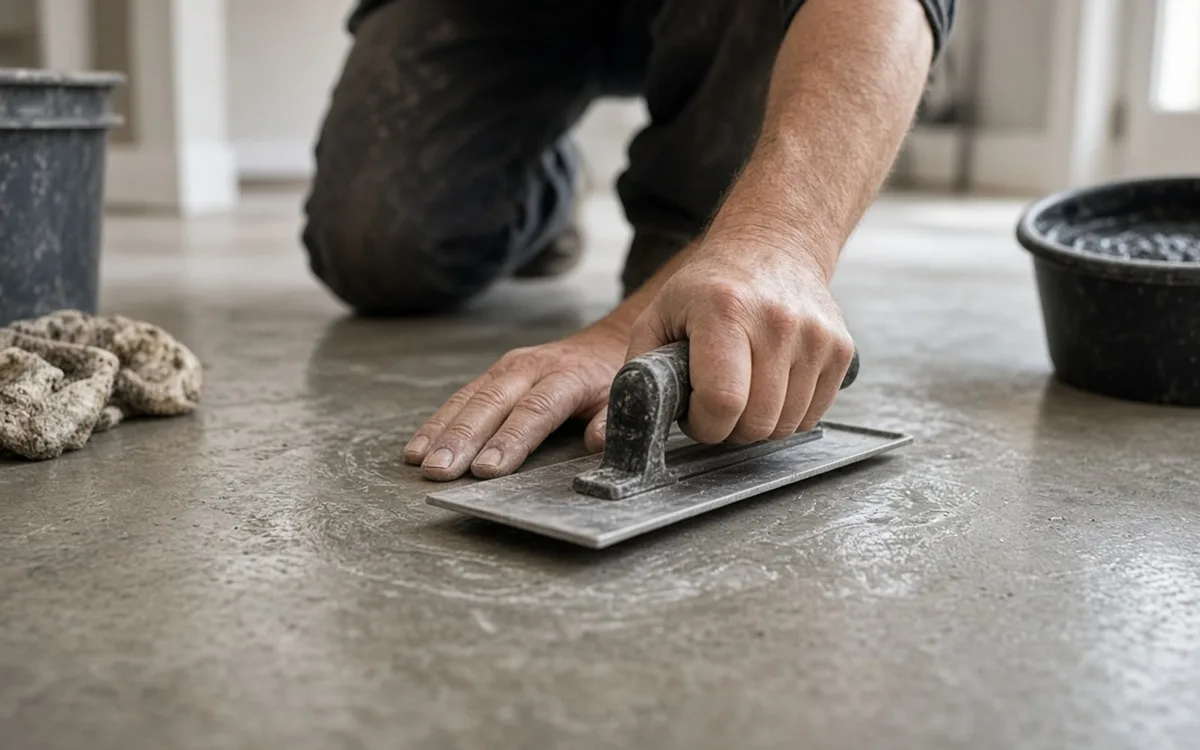
Commercial polishing runs about $3 to $8 per square foot on a sound slab in 2026, with matte finishes at the low end and high gloss up to $15. Most commercial projects land at $5 to $8. Gloss level, slab condition, repairs, removal of old coatings, edge work around racking, and project size drive the price; resealing every three to five years is the main ongoing cost.
Polished concrete is often the lowest lifecycle-cost floor for dry facilities, but installed prices vary widely because the finished product depends on the slab. Two warehouses of the same size can differ by double in price if one has a clean, sound slab and the other has old coatings, oil stains, and cracked joints.
This guide explains how polishing is priced, what adds to it, and what a facility can do to control cost. The cost table on this page lists the main line items and the calculator gives a range for your area, so the sections focus on what drives those figures and how to budget around them.
| Item | Low | High | Unit | Notes |
|---|---|---|---|---|
| Commercial polishing, existing sound slab | $3 | $8 | per sq ft | Stelr 2026; Angi commercial example $5–$12 |
| Level 1 matte (1–2 passes) | $3 | $6 | per sq ft | Stelr 2026 |
| Level 4 high gloss (4–6 passes) | $6 | $15 | per sq ft | Stelr 2026 |
| Existing floor removal | $1 | $3 | per sq ft | Airtasker 2025 |
| Crack and spall repair | $1 | $3 | per sq ft | Airtasker 2025 |
| Resealing every 3–5 years | $0.85 | $1.6 | per sq ft | This Old House 2026 |
| Small jobs under 500 sq ft | $8 | $15 | per sq ft | Stelr 2026; setup dominates |
Gloss is set by the number of grinding and polishing passes and the final grit. Stelr maps it as 1–2 to 4–6 passes: Level 1 matte at $3 to $6 per square foot, Level 2 low sheen at $4 to $8, Level 3 medium gloss at $5 to $10, and Level 4 high gloss at $6 to $15. HomeGuide publishes near-identical tiers, $3–$12 per sq ft overall, and puts most commercial projects at $5 to $8.
Aggregate exposure is a second axis. A cream finish, where only the surface paste is polished, costs least; salt-and-pepper exposure of fine aggregate costs more; full aggregate exposure requires deeper grinding and costs most. Stelr prices cream polish at $3 to $8, salt-and-pepper at $5 to $10, and full aggregate at $10 to $15 or more. Choose the lowest gloss and exposure that meet the facility's appearance and cleaning needs.
Polishing is highly sensitive to size because setup, equipment transport, and edge work are largely fixed. Stelr's size bands run from $8 to $15 per square foot under 500 square feet down to $3–$6 per sq ft at 10,000 square feet or more, and its 2,000 square foot retail showroom example totals $10,000 to $24,000, or $5 to $12 per square foot. Large open warehouses are the most economical polishing projects, because the big ride-on grinders run long uninterrupted passes, and there are many of them: our analysis of EIA's 2018 building survey counts 548,000 warehouses and 167,000 distribution or shipping centers.
Stelr puts commercial and industrial polishing at $3–$8 per sq ft, below residential rates, largely because of scale. Angi's commercial benchmark of $5–$12 per sq ft reflects more typical mid-size jobs. When budgeting, use the lower end only for large, open, sound slabs and the upper end for smaller or more complex areas, such as retail sales floors broken up by fixtures or schools with many classrooms and corridors.
The table in this section gives Stelr's April 2026 size bands for installed polishing on a sound slab, before coating removal or repairs.
| Project size (Stelr 2026) | Installed per sq ft | Example total (our arithmetic) |
|---|---|---|
| Under 500 sq ft | $8–$15 | 400 sq ft: $3,200–$6,000 |
| 500–1,000 sq ft | $6–$12 | 800 sq ft: $4,800–$9,600 |
| 1,000–3,000 sq ft | $5–$10 | 2,000 sq ft: $10,000–$20,000 |
| 3,000–10,000 sq ft | $4–$8 | 6,000 sq ft: $24,000–$48,000 |
| 10,000+ sq ft | $3–$6 | 20,000 sq ft: $60,000–$120,000 |
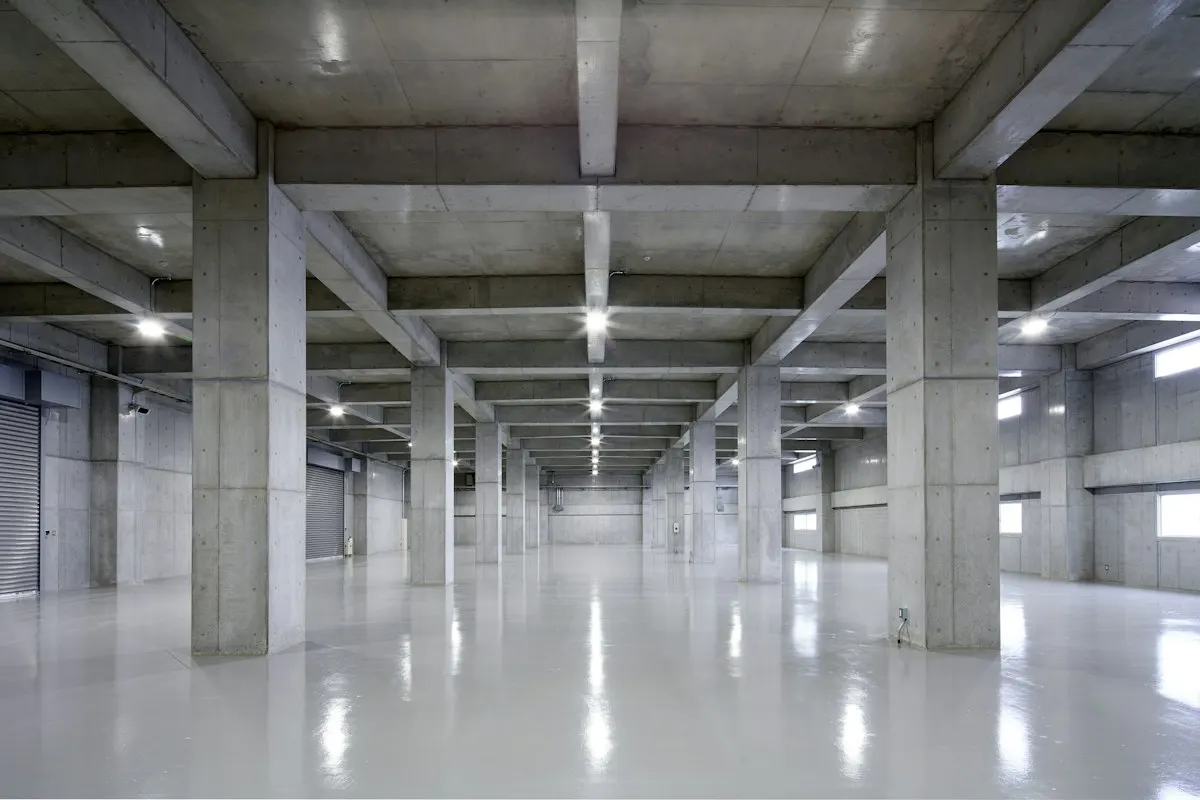
Polishing is mainly labor and machine time. Materials are limited to densifier, guard, joint filler, and abrasives, which are consumed quickly on hard or abrasive concrete. Airtasker's breakdown puts grinding at $1 to $4 and polishing at $2 to $6 per square foot, with sealing at $2 to $4 on residential-scale jobs, which shows how much of the price is the passes themselves.
That means the most effective ways to lower cost are to reduce passes, open up access, and allow continuous work. A matte finish takes fewer passes than high gloss. Moving racking or equipment in advance lets big machines run freely rather than hand-grinding edges. Allowing day shifts in a vacant zone avoids night premiums and repeated setups.
Removal of existing coatings, adhesives, or tile is the largest common add-on, priced at $1 to $3 per square foot in Airtasker's breakdown. Crack, spall, and joint repair is priced as an allowance or by the linear foot and depends on slab condition. Joint filling with semi-rigid filler is usually needed in forklift traffic to protect joint edges.
Stain treatment, oil extraction, and patching are harder to price because they depend on what the slab reveals once grinding starts. Ask for a test area and a unit rate for each repair type, so the budget can flex with conditions rather than turning into a change order. Asbestos-containing tile or mastic, if present, must be abated separately before grinding begins.
This Old House recommends daily dust mopping with a pH-neutral cleaner, periodic auto-scrubbing, and resealing every 3–5 years, at $0.85 to $1.60 per square foot, which is the largest recurring line in a polished floor's budget. HomeAdvisor prices polishing at $2–$16 per sq ft by complexity and cites a service life of 20 years or more when professionally installed.
Over ten years, a 20,000 square foot floor would typically see two reseals at about $17,000 to $32,000 each at This Old House's rates. Heavy traffic lanes may need periodic re-polishing to restore gloss. Compared with coatings that need recoating and cure windows, the maintenance cost and downtime are low, which is the main financial argument for polishing dry facilities.
Polishing needs no cure, so a zone can often return to service the same day it is finished. Cost rises with restrictions: night work, short windows, dust control in occupied areas, and working around fixed racking or equipment. Vacuum extraction is standard for silica control, but occupied facilities may need extra barriers and cleanup.
Phasing across many small windows increases cost through repeated setups. Where possible, release larger contiguous areas for longer windows, even if that means relocating some storage or production temporarily. Ask bidders to price both phased and continuous schedules, so the facility can weigh the premium against the operational cost of releasing more floor at once.
Start with the finish: gloss level, aggregate exposure, number of passes, and final grit. Then check the chemistry, meaning the densifier and guard products, and the preparation, including removal of old coatings, crack and spall repair, and joint filling. Each of these should appear as a line or a stated inclusion; if one is missing, ask whether it is excluded or simply unstated.
Next look at access and schedule: whether racking or equipment is moved and by whom, how edges are handled, the phasing plan, and dust control. Finally, check what the bidder expects the floor to look like, ideally based on a test area on your slab. A bid that promises high gloss on a heavily patched slab without a test area is promising something it cannot know.
Once the lines match, compare totals against the published ranges for your area and gloss level, and against each other. The 2026 cost guide explains how polishing compares with coatings on price, and a large gap between two otherwise identical bids is worth a follow-up call rather than an automatic award to the lower number.
Cut gloss before cutting preparation. A Level 1 or 2 finish usually meets warehouse needs at lower cost than high gloss. Polish only visible or high-traffic areas and grind-and-seal the rest, and move racking in advance to reduce edge work. Do not skip joint filling in forklift areas or crack repair, which protect the floor's life.
Using Stelr's 10,000-plus band of $3 to $6, a 20,000 square foot warehouse budgets roughly $60,000 to $120,000 before removal or repairs; a 5,000 square foot retail floor at HomeGuide's typical $5 to $8 budgets $25,000 to $40,000. Run your own areas in the cost calculator, compare against coatings on the polished versus coated comparison, and see the polishing service page for slab checks.
By the numbers
Planning figures from published U.S. sources; every card links to where the number came from.
$3–$6 per sq ft
Commercial polishing on projects of 10,000+ sq ft runs $3–$6 per sq ft (2026)
Stelr's April 2026 guide prices polishing by project size: under 500 sq ft $8–$15, 500–1,000 $6–$12, 1,000–3,000 $5–$10, 3,000–10,000 $4–$8, and 10,000+ sq ft $3–$6 per square foot. Its 2,000 sq ft retail showroom example totals $10,000–$24,000.
Stelr, polished concrete cost guide 2026 (2026)1–2 to 4–6 passes
Polished concrete gloss takes 1–2 passes (matte, $3–$6) up to 4–6 passes (high gloss, $6–$15)
Stelr maps gloss level to grinding passes and price: Level 1 soft matte $3–$6 (1–2 passes), Level 2 low sheen $4–$8 (2–3), Level 3 medium gloss $5–$10 (3–4) and Level 4 high gloss $6–$15 per square foot (4–6 passes). More passes mean more machine time and downtime.
Stelr, polished concrete cost guide 2026 (2026)$3–$8 per sq ft
Commercial polished concrete runs $3–$8 per sq ft versus $5–$12 residential (2026)
Stelr's 2026 guide prices commercial and industrial polishing at $3–$8 per square foot versus $5–$12 residential, with grind-and-seal at $2–$5, cream polish $3–$8, salt-and-pepper $5–$10 and full aggregate $10–$15+. Jobs under 500 sq ft cost $8–$15 per square foot; 10,000+ sq ft gets bulk pricing.
Stelr, polished concrete cost guide 2026 (2026)$5–$12 per sq ft
Angi benchmark: commercial concrete polishing example at $5–$12 per square foot (2026)
Angi's cost guide for polishing concrete floors, updated April 2026, is the published commercial-polishing example behind this site's calculator.
Angi, cost to polish concrete floors (2026)The calculator uses the same commercial and industrial flooring benchmarks as this guide. Set the size and tier, then request a written estimate to check it against a real proposal.
Homeowner polls
Stelr lists commercial polishing at $3–$8; Ace Avant lists urethane cement at $7–$18 by duty.
No votes yet. Yours will be the first. · saved on this device
No votes yet. Yours will be the first. · saved on this device
No votes yet. Yours will be the first. · saved on this device
Because they may assume different gloss levels, aggregate exposure, repairs, and edge work. One bid may include joint filling and crack repair; another may exclude them. Ask each bidder for gloss level, passes, final grit, repairs, and joint treatment, and whether racking will be moved. Line these up before comparing totals.
Usually not. High gloss requires more passes and costs more, and in a warehouse the difference in performance is small. A matte or low-sheen finish is easier to maintain and often meets the facility's needs. High gloss is more common in retail and public areas where appearance matters.
Airtasker prices removal at $1 to $3 per square foot. The cost depends on the coating type and thickness; thick epoxy or mastic takes longer to remove. Removal can also reveal stains, repairs, and damage that affect the finished appearance. Ask for a test area after removal to confirm the slab will polish to the expected standard.
Yes. Large ride-on grinders cannot reach under racking beams or around base plates, so edges are ground with smaller machines, which is slower and more expensive per square foot. Moving racking gives a more uniform floor but adds its own cost. Ask bidders to price both options.
This Old House recommends resealing every three to five years at $0.85 to $1.60 per square foot. Traffic, cleaning, and the guard product used affect the interval. Heavy traffic lanes may need attention sooner. Build the reseal into the maintenance budget from the start so it happens before wear becomes visible.
Often yes, because a new slab has no coatings, adhesives, or stains to remove and fewer repairs. However, new slabs need to cure adequately before polishing, and finishing quality at the pour affects the result. Coordinating polishing with the concrete contractor during construction can reduce cost and improve appearance.
The polished tier covers grinding, densifying, and polishing a sound slab. Repairs, removal, and phasing are handled by the complexity setting and add-ons. For a slab with heavy repairs or old coatings, choose the heavy removal complexity and add the removal allowance, then compare the result against proposals.
 Industrial Epoxy Flooring · Cost guideIndustrial epoxy and resin flooring cost in 2026
Published 2026 ranges put industrial epoxy systems at about $3 to $9 per square foot, MMA at $8 to $12, and urethane cement at $7 to $18 depending on duty, with large projects dropping to $4 to $8.
 ESD & Anti-Static Flooring · Cost guideESD and anti-static flooring cost in 2026
Craftsman Concrete Floors' published figures put installed ESD resin floors at $3.34 to $13.55 per square foot, falling steeply with size: $6.70 to $13.55 under 5,000 square feet and $3.34 to $4.40 above 20,000.
 Antimicrobial & Healthcare Flooring · Cost guideHealthcare and antimicrobial flooring cost in 2026
Published 2026 figures put healthcare-grade seamless resin at about $3 to $8 per square foot for epoxy and $8 to $15 for urethane cement, plus $2 to $4 per linear foot of integral cove.
 Service guidePolished Concrete Floors
Commercial concrete polishing grinds and densifies the existing slab through progressively finer diamonds until it becomes a hard, dust-free wear surface.
Service guideIndustrial Epoxy FlooringIndustrial resin flooring is a family of seamless systems, epoxy, urethane cement, MMA, and hybrids, bonded to a prepared concrete slab and built to resist the chemicals, loads, temperatures, and cleaning a facility subjects it to.
Service guideESD & Anti-Static FlooringESD flooring is a conductive or static-dissipative floor system, epoxy, urethane, vinyl tile, or rubber, bonded to a grounded conductive layer so that charge on people and carts drains safely.
 Free toolCommercial and industrial flooring cost calculator
Size, material tier and complexity in, a realistic budget range out.
 Free toolCommercial flooring comparisons
Side-by-side tables for the decisions that change the price most.
 Free toolIs your facility flooring requirement complete enough to bid?
8 questions that show what you already know and what to check next.
 Free toolFacility flooring polls: how other managers decided
See what other planners chose and add your vote.
Tell us the size, the condition of what is there now, and what you want to change. Facility Floor Scope passes your request to independent local professionals, who reply with written, no-obligation estimates. The service is free to use.