Was a written flooring requirement in place before contractors were contacted?
No votes yet. Yours will be the first. · saved on this device
Loading...

Specify the floor around the operation it has to support.
Facility Floor Scope helps facility managers and business owners turn loads, chemicals, cleaning, temperature, static, and downtime constraints into a written flooring requirement, then compare resin, polished concrete, ESD, and healthcare systems against it using sourced costs and standards. The proposal request connects you with independent flooring contractors who respond with written scope and pricing at no cost and no obligation.
By the numbers
Every figure links to its published source.
$4–$17 per sq ft
Urethane cement installs for $4–$17 per sq ft; jobs above 50,000 sq ft drop to $4–$8 (2025)
Craftsman Concrete Floors prices urethane cement at $11–$14 per square foot under 3,000 sq ft, $8–$12 for 3,000–10,000, $5–$9 for 10,000–50,000 and $4–$8 above 50,000. Project size is the single biggest price lever. Contractor-published.
Craftsman Concrete Floors, urethane cement flooring cost (2025)$3–$8 per sq ft
Commercial polished concrete runs $3–$8 per sq ft versus $5–$12 residential (2026)
Stelr's 2026 guide prices commercial and industrial polishing at $3–$8 per square foot versus $5–$12 residential, with grind-and-seal at $2–$5, cream polish $3–$8, salt-and-pepper $5–$10 and full aggregate $10–$15+. Jobs under 500 sq ft cost $8–$15 per square foot; 10,000+ sq ft gets bulk pricing.
Stelr, polished concrete cost guide 2026 (2026)$3.34–$13.55 per sq ft
ESD flooring installs for $3.34–$13.55 per sq ft depending on project size (2025)
Craftsman Concrete Floors prices ESD floors at $6.70–$13.55 per square foot under 5,000 sq ft, $3.93–$8.15 for 5,000–20,000 and $3.34–$4.40 above 20,000 sq ft, tested to ANSI/ESD S20.20 and STM 97.1/97.2. Shot blasting adds $0.50–$0.97 and moisture mitigation $1.50–$4.00 per square foot.
Craftsman Concrete Floors, ESD flooring cost (2025)160°F swing, 2–3x daily
Food plant floors see 160°F thermal swings two to three times a day (2026)
Terrapin Construction Group describes 180–200°F steam cleaning followed by 40°F rinse-down, a 160°F swing repeated 2–3 times daily; epoxy tolerates about 120°F of thermal shock versus 250°F+ for urethane cement. Rapid-set urethane reaches foot traffic in 8–12 hours versus 48–72 hours for epoxy.
Terrapin Construction Group, urethane cement flooring for food processing (2026)A floor in a distribution center, a commercial kitchen, an outpatient clinic, and an electronics assembly line are four different engineering problems that happen to share a word. The failures are different too: epoxy that delaminates under wash-down in a food plant, polished concrete that stains under forklift hydraulics, an ESD floor that reads fine on install day and drifts out of spec by the first audit. Craftsman Concrete Floors reports that standard epoxy delaminates within 12–24 months in active food plants, which is a specification failure before it is a product failure.
This site is organized around that idea. Start with the requirement: what rolls on the floor, what spills on it, how it is cleaned, how hot and cold it gets, and how long the area can be out of service. Then compare systems against the requirement using the comparison tables, budget with the square-foot calculator, and use the proposal request to get written scope and pricing from independent contractors who install these systems.
Each guide covers what it costs, what fails first, and how to compare written proposals.
 Service guideIndustrial Epoxy Flooring
Industrial resin flooring is a family of seamless systems, epoxy, urethane cement, MMA, and hybrids, bonded to a prepared concrete slab and built to resist the chemicals, loads, temperatures, and cleaning a facility subjects it to.
 Service guidePolished Concrete Floors
Commercial concrete polishing grinds and densifies the existing slab through progressively finer diamonds until it becomes a hard, dust-free wear surface.
 Service guideESD & Anti-Static Flooring
ESD flooring is a conductive or static-dissipative floor system, epoxy, urethane, vinyl tile, or rubber, bonded to a grounded conductive layer so that charge on people and carts drains safely.
 Service guideAntimicrobial & Healthcare Flooring
Healthcare flooring covers seamless resin, welded sheet vinyl and rubber, and coved, drained systems chosen so that a facility's cleaning and infection-control program can be carried out on them.
Every contractor who walks the floor will ask the same questions, and answering them in advance is what turns four incomparable bids into four comparable ones. Traffic: pallet jacks, forklifts and their tire type, foot traffic volume, and any point loads from racking or equipment feet. Exposure: the chemicals, oils, blood, sugars, or solvents that hit the floor and for how long. Cleaning: the agents, water temperature, and whether the method is a mop, an auto-scrubber, or a 180°F steam wash-down. Thermal range: freezers, ovens, and loading docks that swing between them.
Then the constraints that are not about the floor itself. Shutdown windows, whether the area can be phased, what must stay running next to the work, and who signs acceptance. Slip resistance targets, static-control limits, or infection-control requirements if any of those apply, with the standard named. A one-page brief covering these items is the document the proposal request is built around, and it is the document every proposal should be checked against.
Commercial flooring is a large, specification-driven market. Floor Covering News' 2024 statistical report puts U.S. commercial flooring sales at $7.227 billion in 2023, about 29% of all U.S. flooring, with roughly 70% of it specified contract work rather than walk-in retail. Healthcare is the largest segment at 44% of commercial sales in FCNews' breakdown, followed by education at 23%, which is why hygienic and seamless systems get so much specification attention.
The building stock those floors go into is enormous and mostly old. The EIA's 2018 Commercial Buildings Energy Consumption Survey counts 548,000 warehouse buildings covering 7,050 million sq ft, 137,000 health care buildings, and 267,000 vehicle service or repair buildings, out of 5.9 million commercial buildings in all. Those are stock figures, not annual flooring demand, and manufacturing plants fall outside CBECS entirely, but they frame how much floor area is running on slabs that were never specified for today's operation.
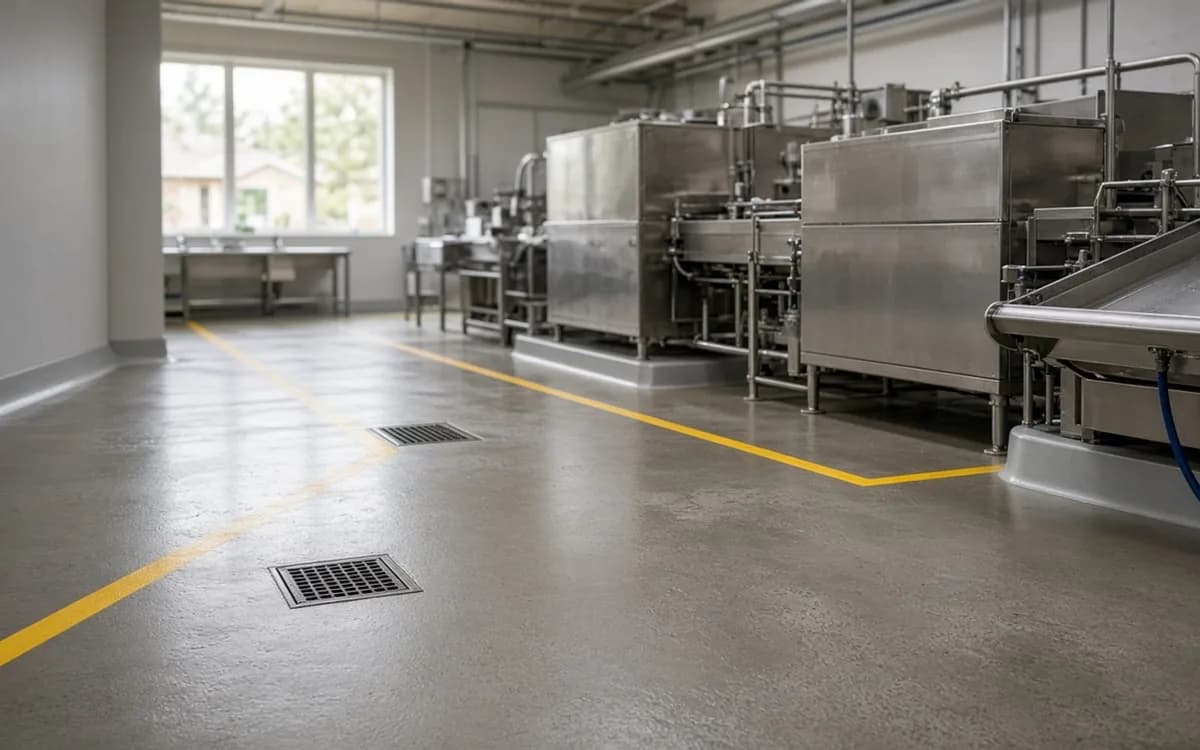
The honest answer is that the range spans an order of magnitude, and project size is the biggest single lever. Angi's commercial polishing example, the benchmark this site's calculator uses, is $5–$12 per sq ft. Stelr's 2026 guide puts commercial polished concrete at $3 to $8 versus $5 to $12 residential, with jobs under 500 square feet at $8 to $15 and 10,000-plus square feet at $3–$6 per sq ft. Ace Avant's 2026 guide lists epoxy at $3 to $9, standard urethane cement at $7 to $13, and thermal-shock-rated urethane cement at $12 to $18.
Craftsman Concrete Floors shows the size effect directly: urethane cement at $11 to $14 per square foot under 3,000 square feet, falling to $4 to $8 above 50,000. ESD floors follow the same curve, from $6.70 to $13.55 under 5,000 square feet down to $3.34 to $4.40 above 20,000. Mobilization, mockups, and testing are fixed costs; spread over a small area they dominate. The calculator models that with a size-sensitive base and flat allowances for moisture mitigation, coves, and testing.
| System | Installed per sq ft | Typical fit | Source |
|---|---|---|---|
| Polished concrete (commercial) | $3–$8 | Warehouses, retail, showrooms with dry, sound slabs | Stelr 2026; Angi $5–$12 example |
| Epoxy coating | $3–$9 | Dry manufacturing, light chemical exposure | Ace Avant 2026 |
| Urethane cement, standard duty | $7–$13 | Wet processing, forklift traffic | Ace Avant 2026 |
| Urethane cement, thermal shock | $12–$18 | Wash-down kitchens, food plants, freezers | Ace Avant 2026 |
| MMA (methyl methacrylate) | $8–$12 | Overnight turnarounds, cold rooms | Terrapin 2026 |
| ESD flooring | $3.34–$13.55 | Electronics, data centers, aerospace | Craftsman 2025 |
Bid price is the easiest number to compare and the least useful. Terrapin Construction Group describes a 65,000-square-foot food plant that chose $6.50-per-square-foot epoxy over urethane cement to save about $350,000, then spent $1.1M replacing the failed floor plus two to three extra days of downtime. Jinyu's 2026 guide estimates that one urethane cement installation outlasts three to five epoxy cycles in wet processing. Neither source is neutral, since both sell urethane cement, but the mechanism they describe is real: thermal shock and wash-down destroy rigid coatings.
The opposite mistake is just as common: specifying a $15-per-square-foot thermal-shock system for a dry warehouse that would be well served by $4 polished concrete. This Old House puts polished concrete's ongoing cost at resealing every 3–5 years at $0.85 to $1.60 per square foot, against daily dust mopping, which is why it dominates distribution and retail. The polished concrete page and the resin flooring page each explain where their system's lifecycle math holds and where it does not.
Floors are a safety line item, not only a capital one. The 2022 Liberty Mutual Workplace Safety Index, republished by the National Floor Safety Institute, ranks falls on the same level as the second most costly cause of disabling workplace injury at $10.26 billion/yr in direct costs, with slips and trips without a fall adding $2.52 billion. The Bureau of Labor Statistics counts 479,480 days-away-from-work cases from falls, slips, and trips in 2024. The National Safety Council puts the total cost of U.S. work injuries at $176.5 billion in 2023, and surface texture, drainage, and coefficient of friction are among the few contributing variables a facility directly controls.
The compliance hook is OSHA's Walking-Working Surfaces rule, 29 CFR 1910 Subpart D, which requires floors to be kept clean, dry, and free of hazards. Food facilities commonly specify wet static coefficient of friction of ≥0.60 wet SCOF under ANSI/NFSI B101.1, according to Jinyu's compliance guide. Ask every resin contractor which texture grade they propose, which test method they will use to verify it after installation, and how that texture affects cleaning. A floor that is safe but cannot be cleaned to the sanitation standard is a different failure.
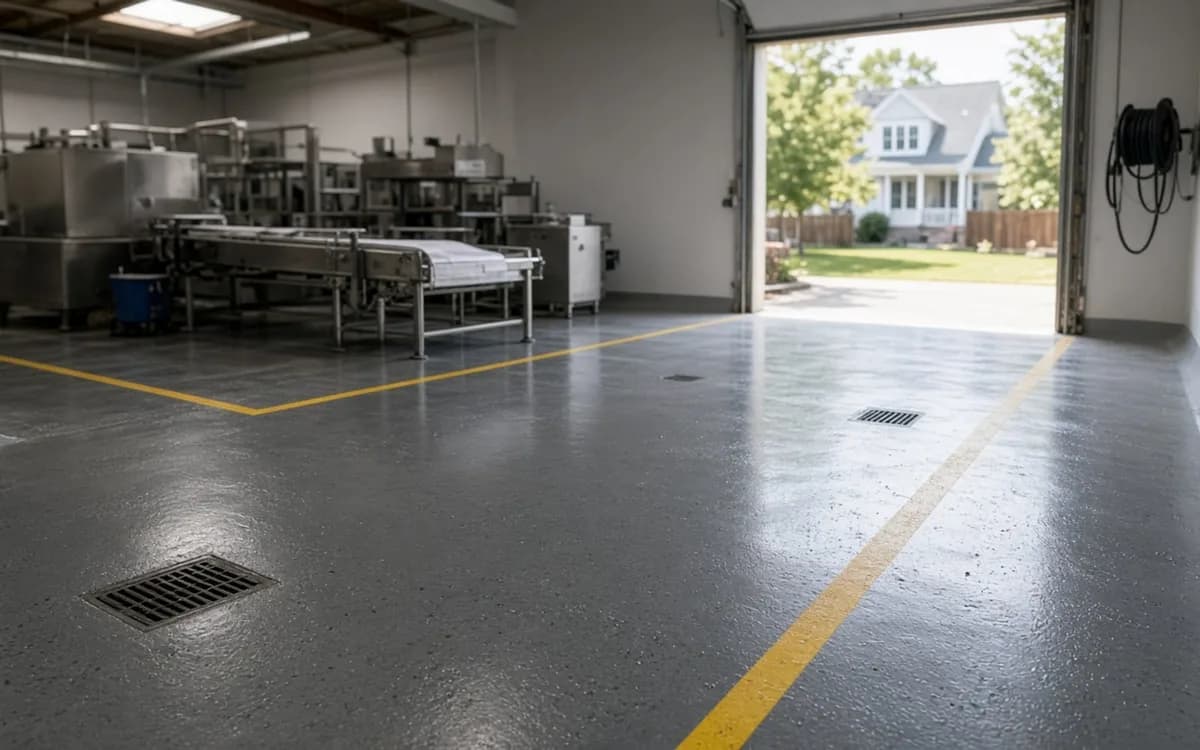
Return-to-service is a specification item, not a scheduling afterthought. Craftsman lists self-leveling urethane cement at 24 hrs / 48–72 hrs before trowel-applied builds, and Terrapin puts rapid-set urethane at foot traffic in 8 to 12 hours versus 48 to 72 hours for epoxy. MMA systems cure in hours and tolerate cold, which is why they appear in overnight retail and cooler work. Polished concrete has no cure at all, but a multi-pass high-gloss finish takes machine time: Stelr maps 1 to 2 grinding passes for matte and 4 to 6 for high gloss.
Phasing is the other lever. An occupied warehouse can be done aisle by aisle with barriers and negative air; a commercial kitchen usually cannot, so the schedule is a single shutdown and the system is chosen for the shortest cure. Every proposal should state walk-on, roll-on, wash-down, and full-chemical-exposure times separately, at the slab temperature the contractor assumes. The facility polls track which downtime windows other managers had to work within.
Two requirements override everything else when they apply. Static control turns the floor into one component of a system with grounding, footwear, and operating procedures, tested to ANSI/ESD S20.20 with resistance measured under STM 97.1 and 97.2; Craftsman's published ESD project costs run from $3.59 per square foot on a 67,000-square-foot data center to $10.15 on a 3,200-square-foot aerospace facility. The ESD flooring page covers what the acceptance test must include.
Infection control in healthcare turns seams, coves, and cleaning-agent compatibility into the specification. CDC's 2023 prevalence survey found 1 in 38 hospital patients had a healthcare-associated infection on a given day; floors are one part of the environmental controls, and an antimicrobial label on a product is not evidence that an installed system meets a facility's infection-control program. The healthcare flooring page explains what evidence to require.
Check each proposal against the written requirement, line by line. Substrate: moisture testing method and result, surface preparation method and profile, crack and joint treatment. System: named products for every layer, thickness, texture grade, and the product data supporting the exposures in the brief. Details: coves, drains, transitions, equipment interfaces, and terminations at walls and doors. Schedule: phasing plan, return-to-service times by activity, and what happens if a moisture test fails. Acceptance: mockup, tests, who signs, and warranty terms with exclusions.
Then normalize the price per square foot for the same scope. Two bids $30,000 apart on a 10,000-square-foot floor may differ by a moisture mitigation layer, which Jinyu prices at $2 to $4 per square foot, or by cove base at $2 to $4 per linear foot. The services overview lists what each system's proposal should contain, and the references guide explains how to verify a contractor's earlier installations at facilities like yours.
The proposal request captures the facility type, area, operation, exposures, cleaning method, shutdown windows, and any existing specification. That brief goes to independent flooring contractors who install the relevant systems in your region. They contact you to arrange a site walk, take substrate readings, and return written scope and pricing. There is no fee to the facility and no obligation; you evaluate the proposals with your own specifier or operations staff and award, or not, on your own terms.
Facility Floor Scope does not install floors, does not employ crews, and does not rank contractors. It publishes sourced planning information so that the proposals can be read critically. Any performance claim in a proposal should be checked against the product data sheet and the standard named in your requirement.
Homeowner polls
Vote to see live results from other facility teams planning the same project.
No votes yet. Yours will be the first. · saved on this device
No votes yet. Yours will be the first. · saved on this device
No votes yet. Yours will be the first. · saved on this device
 Free toolCommercial and industrial flooring cost calculator
Size, material tier and complexity in, a realistic budget range out.
 Free toolCommercial flooring comparisons
Side-by-side tables for the decisions that change the price most.
 Free toolIs your facility flooring requirement complete enough to bid?
8 questions that show what you already know and what to check next.
 Free toolFacility flooring polls: how other managers decided
See what other planners chose and add your vote.
For a straightforward warehouse polish or a dry-area coating, an operations-led brief is usually enough. For ESD, healthcare, food processing, or any floor tied to a regulatory program, a qualified specifier or the responsible facility professional should define the performance limits and acceptance tests before bids are compared. Contractors can propose systems; they should not be the ones defining your compliance requirement.
Craftsman lists 1 to 3 weeks of lead time from contract for urethane cement, then installation at a pace set by area and phasing, then cure of 24 to 72 hours depending on system. Polished concrete has no cure but proceeds at grinding-pass speed. A 10,000-square-foot floor is typically a one-to-two-week site presence; phased occupied work stretches that.
Often, with phasing, dust control, negative air, and barriers. Warehouses, retail, and offices are commonly done in sections or off-hours. Wet-process kitchens and cleanrooms are harder because odors, dust, and cure times conflict with operations. Say in the brief what must keep running and what can shut down; the proposals will show which contractors have a workable plan.
A slab with high vapor emission or internal relative humidity above the flooring manufacturer's limit will lift most bonded systems. Mitigation is a moisture-tolerant epoxy or cementitious layer applied first. Craftsman prices it at $1.50 to $4.00 per square foot for ESD work and Jinyu at $2 to $4. Every proposal for a bonded system should include the moisture test method and what happens if the reading is over.
For dry manufacturing with rubber-tired traffic and no aggressive chemicals, often yes. Where hydraulic fluid, acids, sugars, or wash-down are routine, bare concrete stains and etches; a resin system is the usual answer. Forklifts with hard polyurethane wheels also wear polished surfaces faster at turning points. The polished concrete page lists the exposures that rule it out.
Name the standard and the value. Jinyu's compliance guide cites a wet static coefficient of friction of 0.60 or higher under ANSI/NFSI B101.1 as the common food-facility expectation; other facilities use dynamic COF methods. Then ask the contractor which texture grade meets it, how it will be tested after installation, and how it affects cleaning, because coarse texture holds soil.
No. The request goes to independent contractors who may respond with a site walk and a written proposal. You are free to collect several, share them with your own specifier, and award or not. Facility Floor Scope charges no fee to facilities and does not take part in the contract.
Because scope varies. One bid may include moisture mitigation, cove base, and a thermal-shock-rated system; another may assume a dry slab and a standard build. Project size also moves the price: Craftsman shows urethane cement falling from $11 to $14 per square foot under 3,000 square feet to $4 to $8 above 50,000. Line-item comparison against your brief is the only fair method.








 LocationsRegional planning notes
How climate, codes and prices change a project across U.S. regions.
 ArticlesPlanning articles
Cost guides, checklists and mistakes to avoid before you sign.
 ReviewsHow to read reviews
What genuine contractor reviews look like and what they leave out.
Tell us the size, the condition of what is there now, and what you want to change. Facility Floor Scope passes your request to independent local professionals, who reply with written, no-obligation estimates. The service is free to use.