Was a written flooring requirement in place before contractors were contacted?
No votes yet. Yours will be the first. · saved on this device
Loading...
Facility Floor Scope · Polls
These polls ask facility managers and business owners what system they specified, what shutdown window they had, who wrote the requirement, what they budgeted per square foot, whether acceptance was tested, and what they would change.
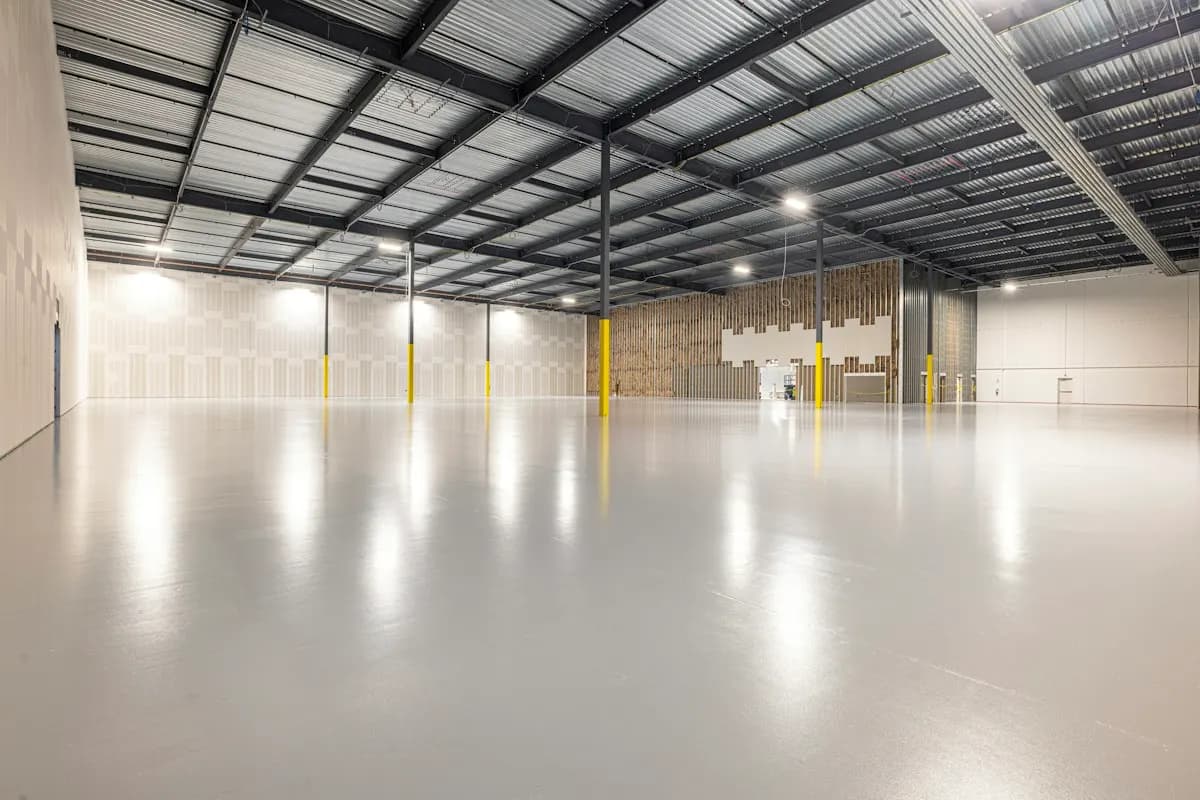
Go to the pollsPhoto: Craftsman Concrete Floors · License.
Every poll below is answered by visitors planning commercial and industrial flooring. Results update the moment you vote, one vote per poll per browser, and your own choices stay highlighted so you can compare them with everyone else's. Nothing here is a sales survey; use it to see which trade-offs other homeowners are weighing before you request estimates.
16 polls · newly opened, so every vote shapes the first results · results saved on this device. Vote on any poll you have not answered; your own votes are highlighted.
No votes yet. Yours will be the first. · saved on this device
No votes yet. Yours will be the first. · saved on this device
No votes yet. Yours will be the first. · saved on this device
No votes yet. Yours will be the first. · saved on this device
No votes yet. Yours will be the first. · saved on this device
No votes yet. Yours will be the first. · saved on this device
Terrapin rates epoxy at about 120°F of thermal shock and urethane cement at 250°F or more.
No votes yet. Yours will be the first. · saved on this device
No votes yet. Yours will be the first. · saved on this device
No votes yet. Yours will be the first. · saved on this device
Stelr lists commercial polishing at $3–$8; Ace Avant lists urethane cement at $7–$18 by duty.
No votes yet. Yours will be the first. · saved on this device
No votes yet. Yours will be the first. · saved on this device
No votes yet. Yours will be the first. · saved on this device
No votes yet. Yours will be the first. · saved on this device
No votes yet. Yours will be the first. · saved on this device
No votes yet. Yours will be the first. · saved on this device
No votes yet. Yours will be the first. · saved on this device
By the numbers
Poll results above are from visitors to this site; these figures come from published research.
548,000
U.S. warehouse buildings on 7.05 billion sq ft (EIA CBECS 2018)
The EIA's 2018 Commercial Buildings Energy Consumption Survey Table B15 counts 548,000 warehouse buildings (RSE 9.3%) with 7,050,000,000 square feet of gross floorspace (RSE 10.6%). Historical stock, not current flooring sales; industrial manufacturing is outside CBECS scope.
EIA 2018 CBECS Table B15: building activity subcategories (2018)$7.227 billion
U.S. commercial flooring sales totaled $7.227 billion in 2023, down 1.5%
Floor Covering News' 2024 Stats report puts commercial flooring at $7.227 billion in 2023, a 1.5% decline versus a 10.1% drop for the overall flooring industry. Commercial represents roughly 29% of total U.S. flooring sales.
Floor Covering News, STATS 2024 commercial market (2024)6,400 per year
BLS projects about 6,400 flooring occupation openings a year, 2025–2035
BLS projects 4% employment growth for flooring installers and tile and stone setters from 2025 to 2035 with roughly 6,400 openings per year, mostly replacement. Projections are not observed future demand; wages exclude self-employed workers.
BLS Occupational Outlook Handbook, flooring installers and tile and stone setters (2025)137,000
U.S. health care buildings on 4.02 billion sq ft (EIA CBECS 2018)
CBECS 2018 counts 137,000 health care buildings with 4,018,000,000 square feet of gross floorspace, plus 38,000 nursing home or assisted living buildings on 1.5 billion square feet. Stock context for healthcare flooring, not annual demand.
EIA 2018 CBECS Table B15: building activity subcategories (2018)Published guides say what a floor should cost and which standard applies; they do not say what the plant across town specified or what its manager wishes had been in the brief. The polls fill that gap informally. Each is anonymous and takes a second, and the results show the split among visitors to this site, who skew toward people actively scoping a project. The most useful polls are the ones on downtime and acceptance testing, because those two answers change the system, the crew size and the schedule more than any finish choice. Read them as a room of peers with the same question, not as a study.
The first group asks the specification questions: whether a written brief existed before proposals, who wrote it, and whether lifecycle cost or bid price decided the award. The second asks about the facility and exposures, since a floor chosen for a distribution center and one for a wash-down kitchen are different problems; the EIA's CBECS counts 548,000 warehouse buildings, 137,000 health care buildings, 437,000 education buildings, and 66,000 hotels, and the polls separate them. The third asks about downtime and phasing, the fourth about budget and proposals, and the fifth about safety and compliance testing.
As a distribution, not a recommendation. If most visitors specified urethane cement, that reflects who visits a site about industrial floors and what contractors in their markets propose, not a finding that urethane cement fits your slab. The useful polls are the regret and surprise ones: what the site walk found that changed the scope, and what managers would put in the next brief. Those are the questions to raise before your own proposals, and the resin flooring page explains the usual surprises.
For population-level figures the site relies on named sources. Floor Covering News' $7.227 billion in 2023 commercial sales and BLS' count of 97,000 flooring jobs carry weight; a poll here does not. The two are shown together so the difference is visible.
Patterns in specification polls are predictable and still useful. Briefs written by operations staff cover traffic and cleaning well and thermal cycles poorly; briefs written by purchasing cover price and schedule and little else. Shutdown-window answers split between facilities that can phase and facilities that cannot, which is the same split that decides fast-cure systems. Budget answers cluster below published midpoints until the first proposal arrives, and the gap is usually preparation and mitigation. The surprise poll is dominated by moisture over the limit and an old floor under the current one, which is why the proposal request asks for slab history.
None of that replaces a site walk and a mockup, but it tells you what to bring to one. If most visitors who chose polished concrete regret the dock lanes, and your facility has docks, that is a signal to specify a stain guard and a lower gloss at the doors before the proposals are written.
Options are mutually exclusive and neutral so a result means something. A poll asking whether the new floor is satisfactory produces the expected answer; one asking what the next brief will include produces a list a manager can act on. Where possible the polls mirror the decisions on the comparison page and the inputs on the calculator, so you can see how others answered the questions you are working through. Take the specification quiz if the results made you second-guess a choice.
No. The site labels them as such and cites named sources such as Floor Covering News, BLS, and the EIA's CBECS when it needs a population-level figure.
Each poll accepts one vote per browser. Results update as votes arrive and show percentages with the vote count so you can judge how much weight a small sample deserves.
No. Votes are anonymous and are not linked to the proposal request or any account. The site stores only the option chosen and a marker to prevent repeat votes from the same browser.
Because it predicts what the brief leaves out. Operations-written briefs miss thermal cycles; purchasing-written briefs miss acceptance testing; contractor-written briefs favor the contractor's system. Seeing the split is a nudge to have the right people review the brief before proposals.
The polls are revised periodically based on the questions facilities ask most on the proposal request. If a decision you faced is missing, the contact page is the place to mention it.
No. Matching is by region and the systems requested. Poll votes are not connected to the request form and do not affect who receives a brief.
Lightly. A poll shows what a few hundred visitors chose; a published figure such as FCNews' 44% healthcare share of commercial sales comes from a defined trade-press method. Use polls for perspective and statistics for planning.
 Free toolCommercial and industrial flooring cost calculator
Size, material tier and complexity in, a realistic budget range out.
 Free toolCommercial flooring comparisons
Side-by-side tables for the decisions that change the price most.
 Free toolIs your facility flooring requirement complete enough to bid?
8 questions that show what you already know and what to check next.
 Service guideIndustrial Epoxy Flooring
Industrial resin flooring is a family of seamless systems, epoxy, urethane cement, MMA, and hybrids, bonded to a prepared concrete slab and built to resist the chemicals, loads, temperatures, and cleaning a facility subjects it to.
 Service guidePolished Concrete Floors
Commercial concrete polishing grinds and densifies the existing slab through progressively finer diamonds until it becomes a hard, dust-free wear surface.
 Service guideESD & Anti-Static Flooring
ESD flooring is a conductive or static-dissipative floor system, epoxy, urethane, vinyl tile, or rubber, bonded to a grounded conductive layer so that charge on people and carts drains safely.
 Service guideAntimicrobial & Healthcare Flooring
Healthcare flooring covers seamless resin, welded sheet vinyl and rubber, and coved, drained systems chosen so that a facility's cleaning and infection-control program can be carried out on them.
Tell us the size, the condition of what is there now, and what you want to change. Facility Floor Scope passes your request to independent local professionals, who reply with written, no-obligation estimates. The service is free to use.