Who wrote or will write the flooring specification?
No votes yet. Yours will be the first. · saved on this device
Loading...

About Facility Floor Scope
Facility Floor Scope is an editorial planning resource for facility managers and business owners specifying commercial and industrial floors. It publishes sourced costs, standards, failure modes, and proposal checklists for resin, polished concrete, ESD, and healthcare flooring, and forwards proposal requests to independent flooring contractors who respond with written scope and pricing. It does not install floors, employ crews, or rank contractors.
Commercial flooring is bought by people who have many other things to buy. A facility manager specifies a floor every several years, while the contractor across the table specifies one every week, and the marketing around industrial, antimicrobial, and anti-static labels is written for exactly that asymmetry. This site exists to close some of it: sourced numbers, named standards, and the questions a specifier would ask, arranged so that a proposal can be read critically.
The second function is practical. When the requirement is written, the proposal request forwards it to independent contractors who install the relevant systems in your region. They respond with written scope and pricing. You compare, consult your own specifier if you have one, and award or not.
Every statistic carries its source, year, and a link. Cost figures come from published guides by Angi, HomeAdvisor, HomeGuide, Stelr, Airtasker, and from contractors and manufacturers such as Craftsman Concrete Floors, Ace Avant, Terrapin Construction Group, and Jinyu; where a contractor or manufacturer published the figure, the prose says so, because those sources favor the systems they sell. Market figures come from Floor Covering News' annual statistical report, which puts 2023 commercial sales at $7.227 billion, and named market-research firms; trade-press totals often trace back to Catalina Research, which supplies the data behind Floor Covering Weekly's statistical issue. Building stock comes from our analysis of the EIA's 2018 Commercial Buildings Energy Consumption Survey, which counts 5.9 million commercial buildings on 96,423 million sq ft. Workforce figures come from the Bureau of Labor Statistics, which counts 45,200 tile and stone setters and 4,700 floor sanders and finishers within the group.
Safety figures come from the Liberty Mutual Workplace Safety Index as republished by the National Floor Safety Institute, BLS injury and fatality data, CDC and NIOSH, and OSHA. Healthcare infection prevalence comes from CDC, whose 2023 survey found 1 in 38 hospital patients with an infection on a given day. The site keeps each figure's period, geography, and denominator: CBECS building counts are 2018 stock, not annual demand; BLS employment covers a broad flooring occupation group, not resin installers alone; a market-research valuation is one firm's definition.
It does not install floors, so it offers no crews, no warranty, and no schedule. It does not rate or rank the contractors who receive proposal requests, and it does not publish testimonials about them. It does not accept product placement and does not adjust cost figures to favor any system. It does not define your compliance requirement: for ESD, healthcare, or food-safety floors, the responsible facility professional or a qualified specifier does that, and the service pages say so on every page where it applies.
It also cannot see your slab. Moisture, contamination, flatness, and joint condition come from a site walk and a mockup, and the calculator and comparisons are meant to prepare you for those, not to replace them.
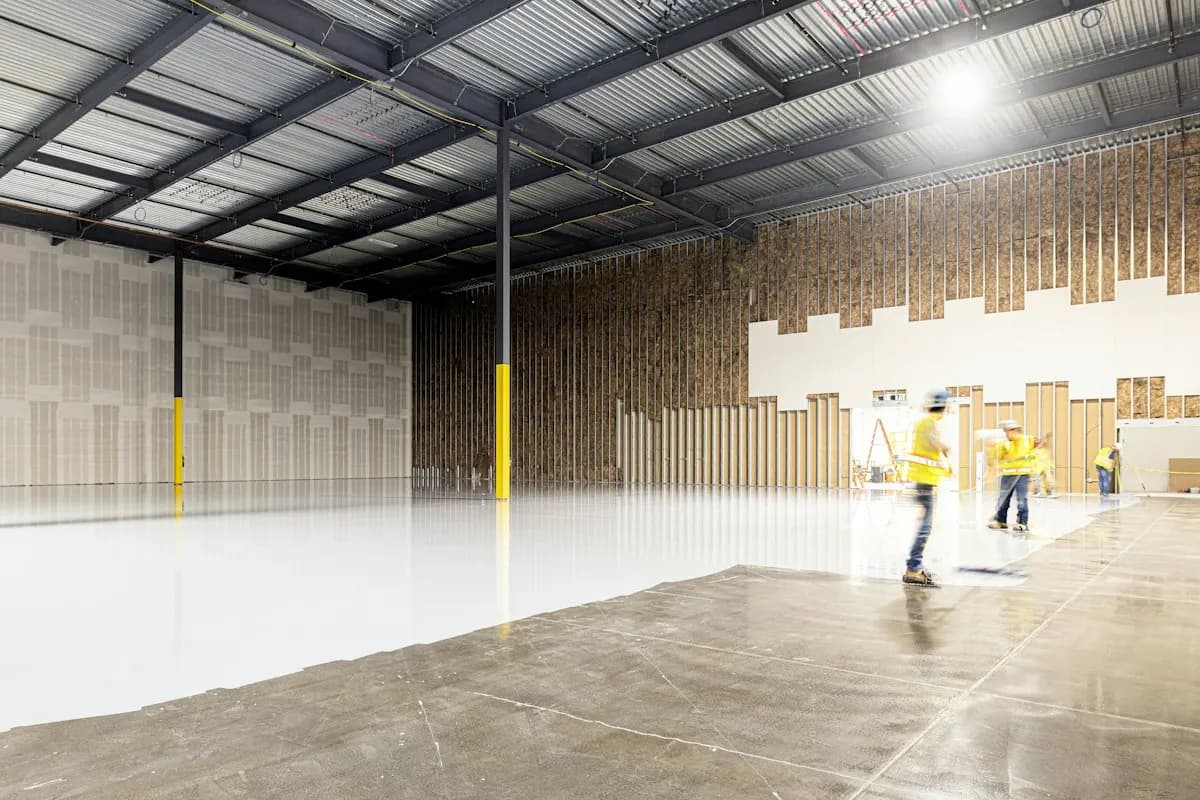
The proposal request captures facility type, area by zone, operation, exposures, cleaning method, shutdown windows, and any existing specification. That brief is forwarded to independent contractors who serve your region and install the systems described. They contact you to arrange a site walk and return written scope and pricing. There is no fee to the facility, no obligation, and no penalty for collecting several proposals and awarding none. Contractors are asked to itemize so proposals can be compared against the brief line by line.
Matching is by region and service type only. If no contractor serves your area for a given system, the form says so rather than forwarding the request somewhere unhelpful.
Write the requirement first, using the brief structure on the proposal request page. Then read the service page for the system the requirement points to and the comparison for any pair you are weighing. Run the calculator by zone with honest preparation assumptions to set a planning range. Take the specification quiz to check that the brief is complete enough to bid. Then request proposals and read them against the checklist on the service page. BLS counts about 97,000 jobs in the flooring occupation group and projects openings at about 6,400 per year; the ones who install industrial systems well will recognize a complete brief and respond to it seriously.
 Service guideIndustrial Epoxy Flooring
Industrial resin flooring is a family of seamless systems, epoxy, urethane cement, MMA, and hybrids, bonded to a prepared concrete slab and built to resist the chemicals, loads, temperatures, and cleaning a facility subjects it to.
 Service guidePolished Concrete Floors
Commercial concrete polishing grinds and densifies the existing slab through progressively finer diamonds until it becomes a hard, dust-free wear surface.
 Service guideESD & Anti-Static Flooring
ESD flooring is a conductive or static-dissipative floor system, epoxy, urethane, vinyl tile, or rubber, bonded to a grounded conductive layer so that charge on people and carts drains safely.
 Service guideAntimicrobial & Healthcare Flooring
Healthcare flooring covers seamless resin, welded sheet vinyl and rubber, and coved, drained systems chosen so that a facility's cleaning and infection-control program can be carried out on them.
Homeowner polls
No votes yet. Yours will be the first. · saved on this device
No votes yet. Yours will be the first. · saved on this device
Neither. It is a planning resource and a matching service. It publishes sourced information and forwards proposal requests to independent flooring contractors. Any contract, warranty, and schedule is between the facility and the contractor it selects.
By service region and the systems they install. The site does not rank them, does not audit every claim they make, and publishes no endorsements. Verify licensing where required, insurance, safety record, and references at comparable facilities directly, as you would with any contractor.
Because project size, system, preparation, and phasing move commercial flooring prices by an order of magnitude. Craftsman's urethane cement pricing falls from $11 to $14 per square foot under 3,000 square feet to $4 to $8 above 50,000. The site keeps ranges attributed rather than blending them into a false single number.
They are specific and current, which is why the site uses them, and they favor what their publishers sell, which is why the site labels them. Craftsman, Ace Avant, Terrapin, and Jinyu all sell urethane cement and all conclude it beats epoxy in wet processing. The mechanism they describe is sound; weigh the framing.
The planning content applies to any facility. Public procurement rules on bidding, bonding, and prevailing wage are the facility's to follow; the proposal request is a way to identify contractors and gather budget-level proposals, not a substitute for a formal solicitation where one is required.
The proposal request collects what is needed to match the facility with regional contractors and forwards it for that purpose only. Contractors who receive the request see the project brief and contact details so they can respond.
Sources are checked when the site is revised, and each figure shows its year. Cost guides move with labor and material markets; a 2025 figure may sit below current bids. Standards are cited by name so you can confirm the current edition with your specifier.
 LocationsRegional planning notes
How climate, codes and prices change a project across U.S. regions.
 ArticlesPlanning articles
Cost guides, checklists and mistakes to avoid before you sign.
 ReviewsHow to read reviews
What genuine contractor reviews look like and what they leave out.
Tell us the size, the condition of what is there now, and what you want to change. Facility Floor Scope passes your request to independent local professionals, who reply with written, no-obligation estimates. The service is free to use.