For ESD floors, who owns the program limits and retest schedule?
No votes yet. Yours will be the first. · saved on this device
Loading...
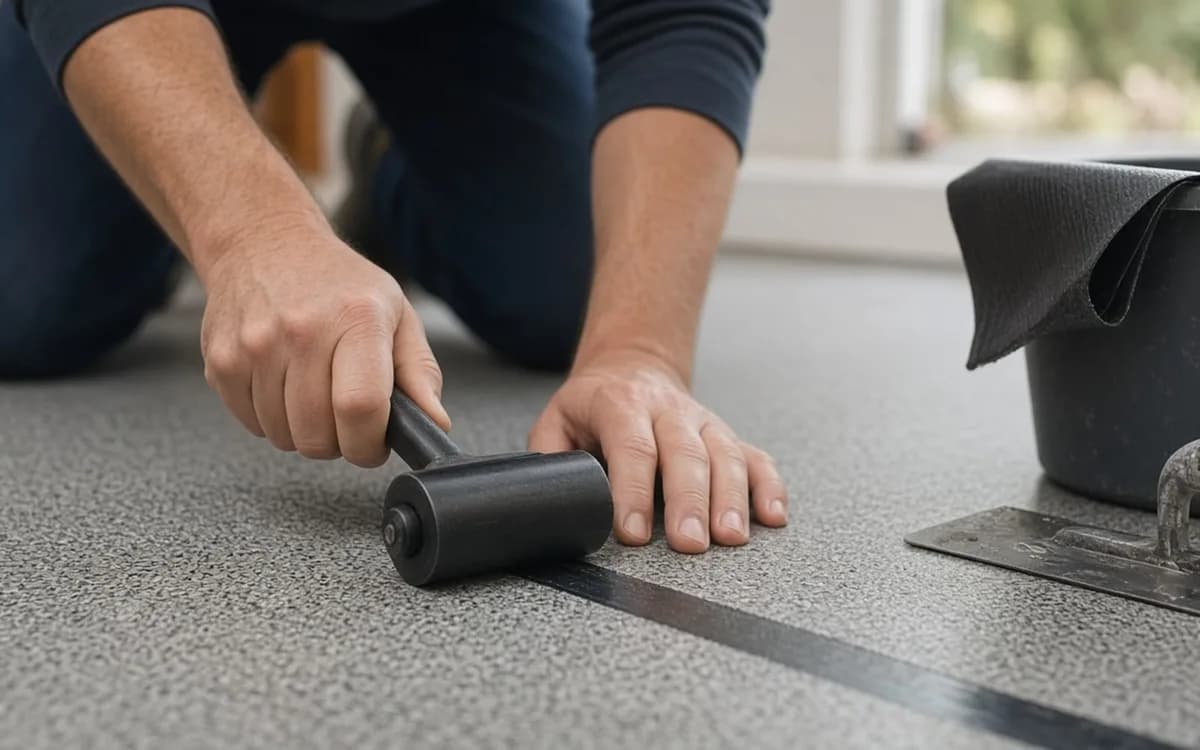
Facility Floor Scope · Service guide
ESD flooring is a conductive or static-dissipative floor system, epoxy, urethane, vinyl tile, or rubber, bonded to a grounded conductive layer so that charge on people and carts drains safely. It suits electronics assembly, data centers, aerospace, munitions, and any facility with a static-control program. It is specified and accepted to ANSI/ESD S20.20 with resistance tested under STM 97.1 and 97.2; installed costs run $3.34 to $13.55 per square foot.
A static-control floor does nothing on its own. It works as one part of a system: the floor, the ground connection, the footwear people wear, and the procedures that keep all three within limits. Craftsman Concrete Floors prices ESD flooring at $3.34–$13.55 per sq ft across project sizes, tested to ANSI/ESD S20.20 and STM 97.1 and 97.2, and its published projects run from $3.59 per square foot on a 67,000-square-foot Houston data center to $10.15 on a 3,200-square-foot aerospace facility.
This page is written for the facility manager or program owner who has to procure that system: what the requirement should say, which floor types meet it, what the acceptance test must include, and what drifts out of spec after installation. If no static-control program exists at the facility, an anti-static floor is a product without a purpose; read the resin flooring page or the polished concrete page instead.
Want the numbers only? Read the esd & anti-static flooring cost guide for 2026 ranges, what moves the price, and sample budgets.
| Item | Low | High | Unit | Notes |
|---|---|---|---|---|
| ESD flooring under 5,000 sq ft | $6.7 | $13.55 | per sq ft | Craftsman 2025 |
| ESD flooring 5,000–20,000 sq ft | $3.93 | $8.15 | per sq ft | Craftsman 2025 |
| ESD flooring over 20,000 sq ft | $3.34 | $4.4 | per sq ft | Craftsman 2025 |
| Shot blasting | $0.5 | $0.97 | per sq ft | Craftsman 2025 |
| Moisture mitigation | $1.5 | $4 | per sq ft | Craftsman 2025 |
| Small repair (about 75 sq ft) | $40 | $63 | per sq ft | Craftsman 2025; mobilization-dominated |
The requirement comes from a program, a customer, or a hazard. Electronics manufacturers and test labs run ANSI/ESD S20.20 programs that specify flooring as part of the grounding path for personnel. Data centers and telecom rooms protect equipment; university research labs, part of the 1,827 million sq ft of college and university floorspace in our analysis of EIA's 2018 building survey, often run programs of their own; aerospace and defense contracts flow static-control clauses down to the floor; munitions and flammable-atmosphere areas treat static as an ignition source and specify conductive rather than dissipative floors. Pharmaceutical fill-finish and cleanrooms sometimes add ESD to particle and cleanability requirements.
In each case the floor requirement is a resistance range measured under a named test method and a system resistance with footwear, plus the grounding design. FCNews puts hard surfaces at ~65% of commercial flooring sales and about 70% of the market in specified contract work, and ESD is the segment where that specification cannot be skipped. If the responsible program coordinator cannot state the limits, the first step is to get them stated by a qualified specifier before any bid, because the contractor cannot define your compliance requirement for you.
Conductive and dissipative epoxy or urethane coatings are applied over a conductive primer with copper grounding strips, giving a seamless surface with the chemical and abrasion resistance of the resin family. Craftsman's cost tiers apply to this type. Static-dissipative and conductive vinyl tile and sheet install over conductive adhesive with ground strips; they are common in assembly and repair areas and can be replaced by the tile. BLS counts 29,800 floor layers outside carpet, wood and hard tile, the trade that sets resilient ESD tile, against 17,400 carpet installers. Conductive rubber offers comfort and durability for standing work at a higher material cost. Carpet tile with conductive fibers serves offices and control rooms, a small but real share of the 553,000 administrative and professional buildings in the 2018 stock.
The categories differ in resistance range: conductive floors are lower resistance and used where ignition risk or very sensitive devices demand fastest discharge; dissipative floors are higher resistance and safer around energized equipment. The right range comes from the program, not the product brochure. All types depend on a continuous grounding layer and correctly spaced ground connections, which is the part most often installed wrong and never tested.
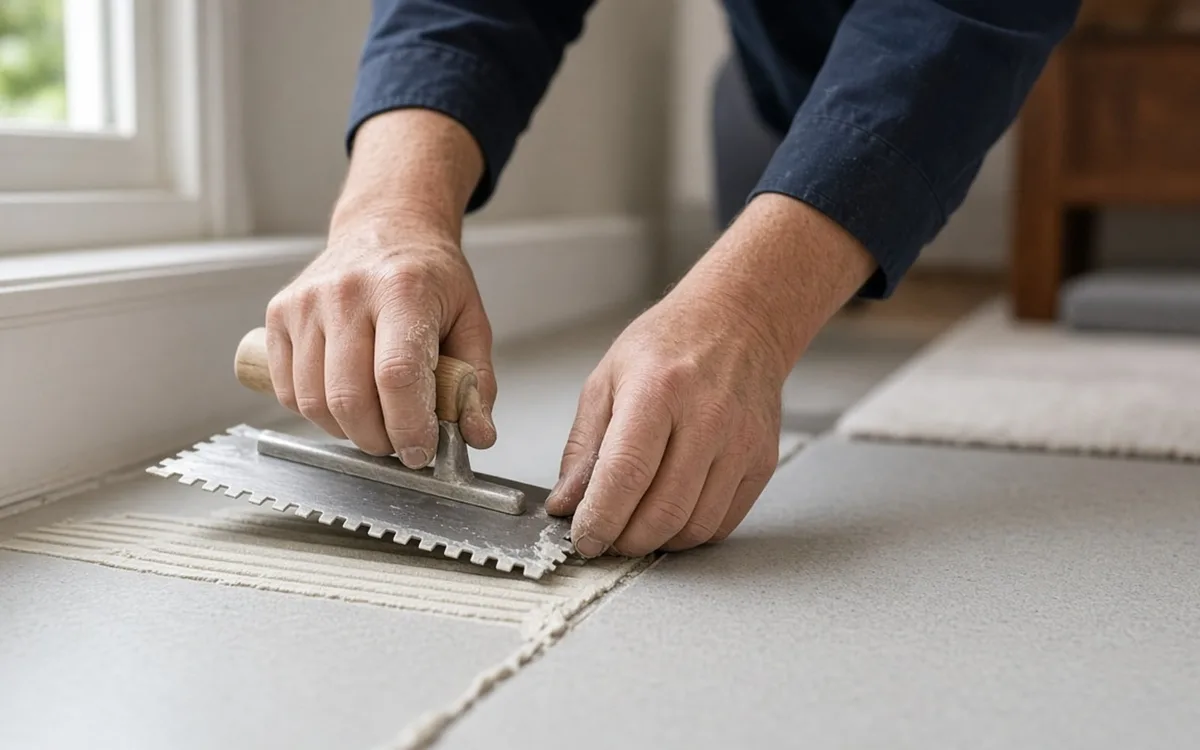
Craftsman's published tiers show the size effect clearly: $6.70 to $13.55 per square foot under 5,000 square feet, $3.93 to $8.15 for 5,000 to 20,000, and $3.34 to $4.40 above 20,000. Its completed projects confirm it: $3.59 per sq ft on 67,000 square feet, $4.21 on a 34,000-square-foot electronics plant, $3.91 on a 114,760-square-foot battery plant, and $10.15 on a 3,200-square-foot aerospace facility. A 75-square-foot repair can reach $63 per square foot because mobilization and testing are fixed.
Preparation and mitigation sit on top. Craftsman lists shot blasting at $0.50 to $0.97 and moisture mitigation at $1.50 to $4.00 per square foot. Grounding hardware, ground strip layout, and the acceptance testing are usually separate lines. Because testing and grounding are fixed costs, ESD projects are among the worst candidates for piecemeal small-area work; batching zones into one mobilization changes the unit price materially. The calculator uses the specialty tier with a testing allowance for this reason.
Preparation follows the same rules as any bonded floor: removal of old coatings, profiling, crack repair, and a moisture test against the system's limit. The conductive primer or adhesive is then applied, with copper or conductive tape ground strips laid at the spacing the manufacturer specifies and terminated to verified building ground points. The dissipative or conductive top layer goes on next, and the whole assembly is left to cure before testing. Coatings follow resin cure times; tile is walkable when the adhesive sets.
The grounding design is where projects go wrong. Ground points must be actual grounds, not painted conduit; strips must be continuous and spaced so every point on the floor is within the specified distance of one; transitions to non-ESD areas need a defined boundary. The installer, the facility electrician, and the program coordinator should agree the ground point locations on a drawing before the primer goes down, because they cannot be moved afterward without cutting the floor.
Acceptance is a measured result under a named method, witnessed and recorded. Resistance to ground and point-to-point resistance are measured per ANSI/ESD STM 97.1 and 97.2 at a grid of locations across the floor, at stated humidity and temperature, with the meter and electrode type recorded. System resistance with the facility's actual footwear is measured for the personnel grounding path. The results are compared against the program's limits, and any out-of-range location is investigated before handover.
Ask for the test plan as part of the proposal: how many points, where, at what humidity, and who witnesses. A contractor who offers a certificate without a grid of readings has not tested the floor. Keep the report; periodic verification is part of an S20.20 program, and the installation baseline is what later readings are compared against. The specification quiz includes the acceptance question because it is the one most often skipped.
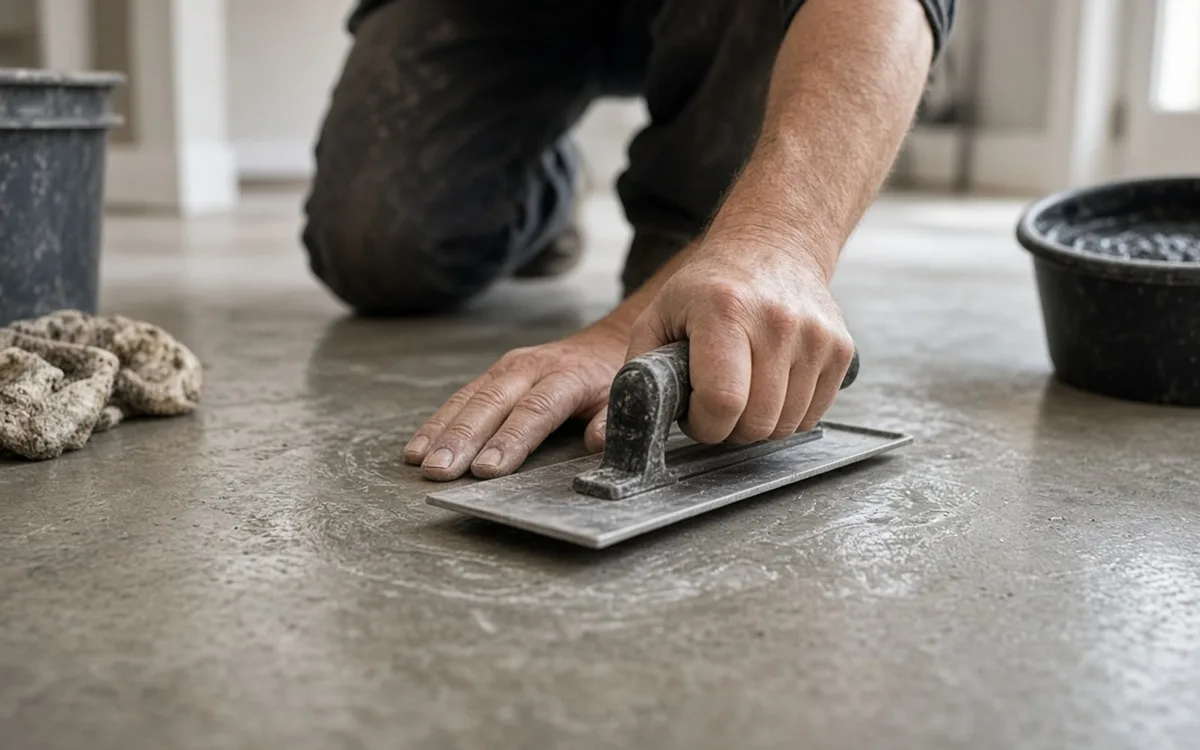
Resistance drifts. Topical floor finishes and waxes applied by cleaning contractors insulate a dissipative floor within months; the cleaning procedure must forbid them and specify compatible cleaners. Low humidity in winter raises readings on some floor types. Dust, mats, and coatings dragged in from adjacent areas create insulating islands. Ground connections corrode or get disconnected during other trades' work. None of these are dramatic, and all of them show up at the next audit as a floor that reads out of spec despite passing at handover.
Physical failures are the ordinary resin or tile failures: delamination from moisture, tile lifting at seams, wear through the dissipative layer in heavy lanes. On a coating, wear-through exposes the conductive primer and changes the reading locally. The maintenance answer is the same across types: a written cleaning procedure, a periodic resistance check on a schedule, and prompt repair of any breach, with the repair tested to the same method.
Humidity is the environmental variable that matters. Dry winter air in northern and mountain facilities pushes resistance up and makes footwear and floor combinations that pass in summer fail in January; the acceptance test should be run at the low-humidity condition or the program should specify humidity control. Humid Southern slabs raise moisture mitigation to a routine line for bonded ESD coatings. Facilities with concrete slabs on grade in any region should test moisture; ESD tile adhesives are as moisture-sensitive as resin. The regional notes cover slab and climate factors.
Start with the standard: does the proposal name ANSI/ESD S20.20, the resistance range, and the STM 97.1 and 97.2 test methods, and does it match the program's limits? Confirm the floor type, the conductive primer or adhesive, ground strip spacing, ground point count and locations, and the boundary detail. Check preparation, moisture test, and mitigation. Confirm the test plan: grid density, environmental conditions, footwear used for system resistance, witnessing, and the report format. Confirm the cleaning procedure and a warranty that covers resistance, not only adhesion.
Then normalize price per square foot and separate the fixed lines. Use the proposal request to get several proposals against the same requirement, and ask each contractor for a facility with a similar program where you can see the acceptance report. The references guide explains what to ask that facility's program coordinator.
Homeowner polls
No votes yet. Yours will be the first. · saved on this device
No votes yet. Yours will be the first. · saved on this device
No votes yet. Yours will be the first. · saved on this device
 Service guideIndustrial Epoxy Flooring
Industrial resin flooring is a family of seamless systems, epoxy, urethane cement, MMA, and hybrids, bonded to a prepared concrete slab and built to resist the chemicals, loads, temperatures, and cleaning a facility subjects it to.
 Service guidePolished Concrete Floors
Commercial concrete polishing grinds and densifies the existing slab through progressively finer diamonds until it becomes a hard, dust-free wear surface.
 Service guideAntimicrobial & Healthcare Flooring
Healthcare flooring covers seamless resin, welded sheet vinyl and rubber, and coved, drained systems chosen so that a facility's cleaning and infection-control program can be carried out on them.
Anti-static is a marketing term with no defined resistance range. Static-dissipative and conductive are defined ranges under ESD standards: conductive is lower resistance for fastest discharge, used where ignition risk or extremely sensitive devices demand it; dissipative is higher resistance and safer near energized equipment. The program specifies which; the floor must test into that range.
Yes. The floor is one half of the personnel grounding path; footwear or heel straps are the other. The system resistance test measures both together with the facility's actual footwear. A floor that passes point-to-point can still fail the system test with insulating shoes.
Only if the existing floor is fully bonded and the manufacturer allows a conductive primer over it, and the ground strips still need to reach real ground points. Most installers prefer removal to bare concrete so the grounding layer is continuous. An adhesion test and the manufacturer's written approval are the minimum.
The program sets the interval, commonly annually or when conditions change, using the same method as acceptance. Retest after any floor repair, after a cleaning contractor change, and after other trades have worked near ground points. Keep every report with the installation baseline.
Usually floor finish. Cleaning crews apply a wax or topical finish that insulates the surface, and readings climb within months. Other causes are winter humidity, disconnected ground points, and wear-through in lanes. A written cleaning procedure that forbids topical finishes prevents the most common one.
Tile is replaceable by the piece and walkable when the adhesive sets, which suits assembly floors with equipment changes. Coatings are seamless and more chemical-resistant, which suits wash-down or solvent areas. Both depend on the grounding layer. Craftsman's cost tiers describe coatings; tile pricing is material-driven and varies by product.
The manufacturer specifies a maximum area per ground connection and strip spacing; the facility electrician confirms that each point is a verified ground. Agree the locations on a drawing before installation. The acceptance grid then confirms every part of the floor is within range of a working ground.
Mobilization, grounding, and testing are fixed, so small areas cost far more per square foot; Craftsman cites $63 per square foot on a 75-square-foot repair. Batching several zones into one visit or scheduling the ESD area with a larger flooring project changes the economics.
 Free toolCommercial and industrial flooring cost calculator
Size, material tier and complexity in, a realistic budget range out.
 Free toolCommercial flooring comparisons
Side-by-side tables for the decisions that change the price most.
 Free toolIs your facility flooring requirement complete enough to bid?
8 questions that show what you already know and what to check next.
 Free toolFacility flooring polls: how other managers decided
See what other planners chose and add your vote.
Tell us the size, the condition of what is there now, and what you want to change. Facility Floor Scope passes your request to independent local professionals, who reply with written, no-obligation estimates. The service is free to use.