Was the floor's compatibility with your actual disinfectants or cleaners confirmed in writing before award?
No votes yet. Yours will be the first. · saved on this device
Loading...
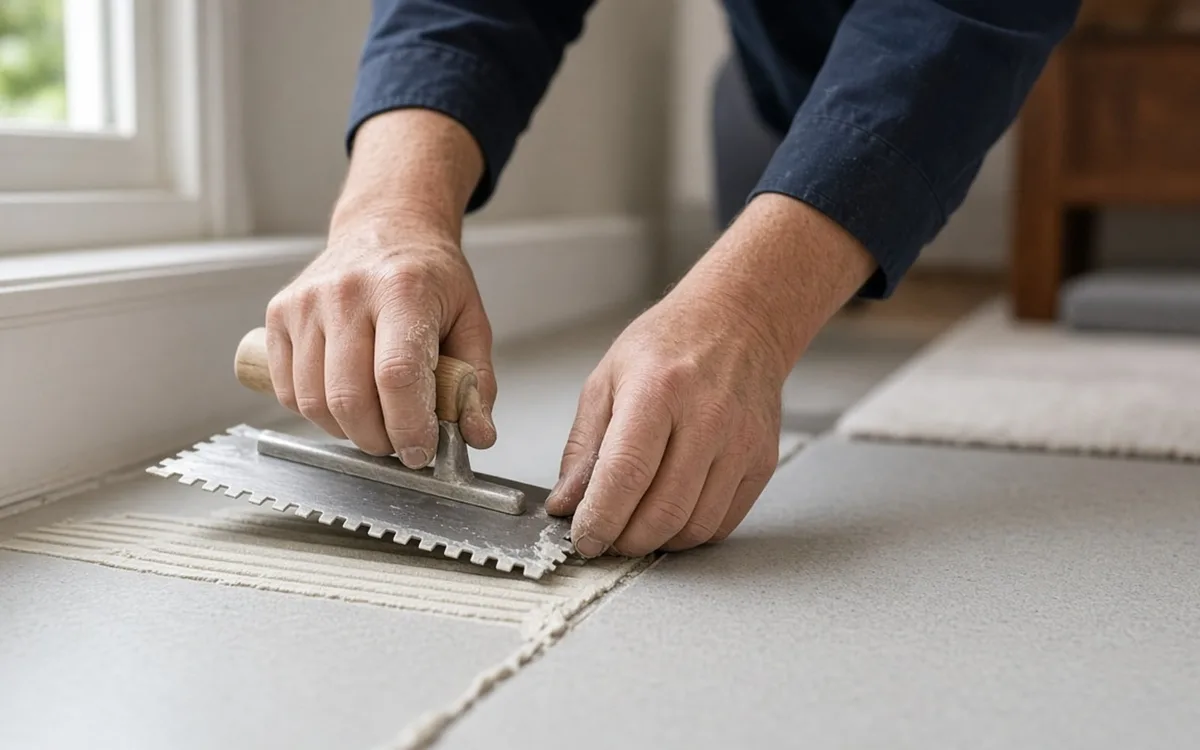
Facility Floor Scope · Antimicrobial & Healthcare Flooring cost guide
Published 2026 figures put healthcare-grade seamless resin at about $3 to $8 per square foot for epoxy and $8 to $15 for urethane cement, plus $2 to $4 per linear foot of integral cove. Removal, abatement, moisture mitigation, and infection-control phasing in occupied buildings often add as much as the floor itself.
Healthcare flooring budgets are shaped as much by the building as by the floor. The resin or sheet itself is often a modest part of the total; removal of old flooring, asbestos abatement in older buildings, moisture mitigation, cove detailing, and the cost of working room by room under infection-control barriers make up the rest.
This guide explains the published ranges, the linear-foot items that matter in small rooms, the premiums of working in occupied care settings, and how to build a realistic budget that a capital committee can approve without later surprises. The cost table and calculator on this page give the per-square-foot ranges; the sections below explain how to use them.
| Item | Low | High | Unit | Notes |
|---|---|---|---|---|
| Epoxy resin system (healthcare-grade, seamless) | $3 | $8 | per sq ft | Jinyu 2026; before coves and phasing |
| Urethane cement resin system | $8 | $15 | per sq ft | Jinyu 2026; wash-down and drain areas |
| Integral resin cove base | $2 | $4 | per linear ft | Jinyu 2026 |
| Moisture mitigation | $2 | $4 | per sq ft | Jinyu 2026 |
| MMA fast-cure system for overnight turnarounds | $8 | $12 | per sq ft | Terrapin 2026 |
| Existing floor removal | $1 | $3 | per sq ft | Airtasker 2025; abatement priced separately |
Jinyu Paint's 2026 guidance prices healthcare-grade epoxy resin systems at $3 to $8 per square foot and urethane cement at $8 to $15, with MMA fast-cure systems at roughly $8 to $12 according to Terrapin for areas that must turn overnight. The range within each system reflects thickness, texture, and the number of layers, including topcoats chosen for chemical resistance.
Welded sheet vinyl and rubber, common in patient rooms and corridors, are priced by product, seam welding, and flash cove. No single published source gives a reliable commercial range for sheet, so request product-specific pricing. Where both are options, compare them room by room using the sheet versus resin comparison.
Healthcare rooms are small, so their perimeter is large relative to their floor area. Integral cove at $2 to $4 per linear foot in Jinyu's figures can add a significant share to a small room's cost. A 150 square foot room with a 50 linear foot perimeter adds $100 to $200 in cove to a floor costing $450 to $2,250 in resin at Jinyu's ranges.
Door thresholds, transitions to corridor flooring, drains in sterile processing and utility rooms, and penetrations for casework or equipment are further linear or per-item costs. Ask each bidder to list cove linear feet, transitions, and drains separately, so the facility can see what the per-square-foot price includes and compare proposals fairly.
Removal of existing flooring adds $1 to $3 per square foot in Airtasker's breakdown. Our analysis of EIA's 2018 building survey counts 137,000 health care buildings on 4,018 million sq ft, plus 38,000 nursing home or assisted living buildings, and many are old. In older healthcare buildings, legacy vinyl tile or mastic may contain asbestos, which requires a survey and licensed abatement as a separate scope before flooring work begins. Abatement cost varies widely and can exceed the new floor's cost in small rooms.
Moisture mitigation at $2 to $4 per square foot in Jinyu's figures is needed where slab moisture exceeds the system's limit. Older slabs without vapor retarders and ground-floor rooms are common candidates. Test before award, include a unit price for mitigation, and budget for it in older buildings rather than hoping readings come back low.
Infection control risk assessment requirements add barriers, negative-pressure containment, HEPA filtration, cleaning at each handback, and often restrictions on hours and routes for materials. Work may be limited to one or a few rooms at a time, with repeated mobilizations. These costs are real but vary too much for a reliable published percentage; ask bidders to price them explicitly.
Downtime cost is often larger than the floor. Every patient room, procedure room, or sterile processing area out of service is lost capacity. Systems that return rooms faster, such as welded sheet overnight or MMA in hours, may cost more per square foot but less overall. Include lost capacity per day in the comparison.
Finance teams often miss this because lost capacity does not appear on the flooring invoice. Ask the department managers for the value of one day of each affected room or service, and include it in the business case alongside the proposals. That figure often justifies paying more for a faster system or a larger crew.
In small rooms, labor dominates. Preparation, cove forming, seam welding, detailing around casework, and cleaning under infection-control protocols take time regardless of room size. Jinyu's breakdown for urethane cement, materials 40 to 50 percent and labor 30 to 40 percent, reflects larger open areas; in healthcare's small rooms the labor share is typically higher.
The flooring workforce is small, with BLS counting 97,000 in the broad occupation group nationally. Crews experienced in healthcare protocols, including barrier construction and infection-control cleaning, are a smaller subset. Scheduling work with experienced crews and releasing groups of adjacent rooms together can reduce labor cost per room and shorten the overall program.
Separate the floor from everything around it. The floor lines are the system, thickness or product, seams, and cove by linear foot. Around them sit removal, abatement coordination, moisture testing and mitigation, transitions, drains, barriers, negative pressure, night work, and cleaning at handback. Proposals that bundle all of this into one number cannot be compared with those that itemize.
Then check the room schedule: how many rooms per phase, how long each room is out of service, and what happens if a room cannot be released on the planned date. Ask for the list of disinfectants the manufacturer has confirmed as compatible. A proposal that answers all of these clearly is showing experience in occupied healthcare buildings, which is often worth more than a small price difference.
Finally, compare the totals against the published ranges and the room count. A bid far below the others often excludes barriers, night work, or cove, and a bid far above may include abatement or drains that the others left out. Normalize those items before deciding, and ask each bidder to confirm in writing what is and is not included.
Cut scope before specification: replace the most worn rooms first, keep existing flooring in areas that are sound and cleanable, and standardize colors and products across rooms. Consider sheet where resin is not required, and group rooms into efficient phases to reduce mobilizations, barrier construction, and repeated infection-control cleaning. Deferring decorative inlays or custom colors is another low-risk saving.
Never cut cove detailing, seam quality, moisture testing, or disinfectant compatibility confirmation; CDC counts 1 in 38 hospital patients with a healthcare-associated infection on a given day. These protect cleanability and the floor's life, and failures in occupied care settings are expensive and disruptive to fix. Floor Covering News puts healthcare at 44% of commercial flooring sales, which means plenty of product choice at each specification level.
A 1,200 square foot sterile processing department in urethane cement at Jinyu's $8 to $15 budgets $9,600 to $18,000 for the floor, plus 200 linear feet of cove at $2 to $4, or $400 to $800, before removal, mitigation, drains, and infection-control costs. A 3,000 square foot lab in epoxy at $3 to $8 budgets $9,000 to $24,000 before the same items.
Run areas through the cost calculator specialty tier, read the healthcare flooring page for specification choices, and see the permits and codes guide for approvals that affect schedule and cost. Then compare the result with written proposals from a site walk, which will reflect the actual slab, room count, and infection-control plan.
By the numbers
Planning figures from published U.S. sources; every card links to where the number came from.
44%
Healthcare is the largest commercial flooring segment at 44% of sales (2023)
FCNews' 2023 breakdown: healthcare 44% and fastest growing, education 23% (K-12 is 75% of that), office and corporate 15% (down from 21% as office vacancy hit 19.8%) and hospitality 13%. Healthcare's share is why seamless and cleanable systems get so much specification attention.
Floor Covering News, STATS 2024 commercial market (2024)97,000
Flooring installers and tile and stone setters held about 97,000 jobs (BLS 2025)
BLS' Occupational Outlook Handbook counts roughly 97,000 jobs in the flooring occupation group in 2025, including 45,200 tile and stone setters, 29,800 floor layers, 17,400 carpet installers and 4,700 floor sanders. A broad group covering residential and commercial work, not resin installers alone.
BLS Occupational Outlook Handbook, flooring installers and tile and stone setters (2025)137,000
U.S. health care buildings on 4.02 billion sq ft (EIA CBECS 2018)
CBECS 2018 counts 137,000 health care buildings with 4,018,000,000 square feet of gross floorspace, plus 38,000 nursing home or assisted living buildings on 1.5 billion square feet. Stock context for healthcare flooring, not annual demand.
EIA 2018 CBECS Table B15: building activity subcategories (2018)1 in 38
hospital patients has a healthcare-associated infection on any given day (2023 survey)
CDC's 2023 prevalence survey found 2.6% of hospitalized patients (about 518,000 HAIs across U.S. acute care hospitals) had at least one infection, 27% lower than 2015. Seamless, cleanable floors are one part of infection-control specifications in healthcare flooring.
CDC, Healthcare-Associated Infections data (2025)The calculator uses the same commercial and industrial flooring benchmarks as this guide. Set the size and tier, then request a written estimate to check it against a real proposal.
Homeowner polls
No votes yet. Yours will be the first. · saved on this device
No votes yet. Yours will be the first. · saved on this device
Stelr lists commercial polishing at $3–$8; Ace Avant lists urethane cement at $7–$18 by duty.
No votes yet. Yours will be the first. · saved on this device
Because small rooms, cove, removal, abatement, and infection-control requirements vary widely between projects. A bid that includes barriers, negative pressure, and night work will be much higher per square foot than one that does not. Ask each bidder to list these items separately, then compare the floor system prices on their own.
Some products include them at no separate charge; others price them as an option. The additive is usually a small part of the total cost. More important for infection control are seamless detailing, cove, and compatibility with the facility's disinfectants. Ask what the additive's claim is based on before paying extra for it.
No published source gives a reliable percentage, because requirements vary with the risk assessment. Barriers, negative-pressure containment, HEPA filtration, cleaning at handback, and restricted hours all add cost. Ask bidders to itemize these, and compare them against the cost of taking larger areas out of service at once.
Often yes, because larger areas reduce mobilizations and allow more efficient crews. The trade-off is taking more rooms out of service at once. Many facilities phase by groups of rooms or by floor. Ask bidders to price several phasing options so the facility can compare cost against operational impact.
The building owner usually contracts abatement directly with a licensed abatement contractor, separate from the flooring contract. In leased space, the lease determines responsibility. Abatement should be completed and cleared before the flooring contractor begins removal or preparation, and its cost should be budgeted separately.
It depends on the product and room. Sheet often installs faster with less downtime, which reduces overall cost in patient areas. Resin may be cheaper in larger back-of-house areas and is better around drains. Compare both on installed cost, maintenance, and downtime per room rather than material price alone.
Record installation date, system, and expected life for each room, then plan replacement in groups to avoid emergency single-room projects. Include routine maintenance, seam and cove repairs, and topcoat renewal for resin. Budgeting across the capital plan lets the facility phase replacements efficiently and keep rooms in service.
 Industrial Epoxy Flooring · Cost guideIndustrial epoxy and resin flooring cost in 2026
Published 2026 ranges put industrial epoxy systems at about $3 to $9 per square foot, MMA at $8 to $12, and urethane cement at $7 to $18 depending on duty, with large projects dropping to $4 to $8.
 Polished Concrete Floors · Cost guideCommercial polished concrete cost in 2026
Commercial polishing runs about $3 to $8 per square foot on a sound slab in 2026, with matte finishes at the low end and high gloss up to $15.
 ESD & Anti-Static Flooring · Cost guideESD and anti-static flooring cost in 2026
Craftsman Concrete Floors' published figures put installed ESD resin floors at $3.34 to $13.55 per square foot, falling steeply with size: $6.70 to $13.55 under 5,000 square feet and $3.34 to $4.40 above 20,000.
 Service guideAntimicrobial & Healthcare Flooring
Healthcare flooring covers seamless resin, welded sheet vinyl and rubber, and coved, drained systems chosen so that a facility's cleaning and infection-control program can be carried out on them.
Service guideIndustrial Epoxy FlooringIndustrial resin flooring is a family of seamless systems, epoxy, urethane cement, MMA, and hybrids, bonded to a prepared concrete slab and built to resist the chemicals, loads, temperatures, and cleaning a facility subjects it to.
Service guidePolished Concrete FloorsCommercial concrete polishing grinds and densifies the existing slab through progressively finer diamonds until it becomes a hard, dust-free wear surface.
 Free toolCommercial and industrial flooring cost calculator
Size, material tier and complexity in, a realistic budget range out.
 Free toolCommercial flooring comparisons
Side-by-side tables for the decisions that change the price most.
 Free toolIs your facility flooring requirement complete enough to bid?
8 questions that show what you already know and what to check next.
 Free toolFacility flooring polls: how other managers decided
See what other planners chose and add your vote.
Tell us the size, the condition of what is there now, and what you want to change. Facility Floor Scope passes your request to independent local professionals, who reply with written, no-obligation estimates. The service is free to use.